Wednesday, February 9, 2011

3 Tips for Safe Travel

"Young Zedi enjoys a glass of water from his new Biosand Water Filter which provides clean, safe drinking water in Wongonyi VIllage, Kenya"

Recently we connected with a group from Olympia, Washington "Water for the World" who are all about building and installing Biosand Water Filters in the developing world. These water filters will provide safe, clean drinking water to those whose only option now is to drink dirty or unsafe water which leads to illness, disease and time away from work and school.


We watched their video in which one of their members had three tips for safe travel in developing countries.


1. DON'T GET HIT - that means watch yourself when travelling by foot or vehicle. In much of the developing world, safety regulations are not as stringent as they are here at home. Matatus and buses are usually overloaded with people and items being transported. Roads are not as well kept as at home which can lead to lots of accidents. If you don't feel safe using public transport because of overloaded conditions, consider hiring your own car and driver.


2. DON'T GET BIT - that means take precautions for malaria and other diseases that are spread by bites from insects. As well as taking malaria pills ( and make sure your doctor prescribes the correct malaria medication for the area you are travelling in as there are different strains of malaria) make sure you use a malaria bednet. These are easily obtained in major cities in shopping centres. We always purchase malaria nets when we get to Nairobi and use them in the village during our stay and leave them to be used by orphans and others who might not be able to afford them.


3. DON'T EAT SHIT - that means, don't drink the local water or eat fresh vegetables that might have been washed in local water. We always eat food that has been cooked. You don't want to spoil you volunteer vacation or your time helping out in a much needed program in a rural village in a developing country because you have a stomach ailment. As well if you are in a remote area, medical help may not be close at hand. We always take our own medical kit each time we go to Kenya with diarrhea medication, gastrolyte and other stomach remedies and again we leave our medical kit behind as our village of Wongonyi, Kenya must use a District Hospital located several kilometres away.


Travelling and working in a developing country is a very rewarding experience and one that can change your life. But the key to staying safe and healthy is using common sense and these three tips.

Tuesday, January 4, 2011

January 11, 2011 - International Day of Peace for Kenya

Peace - it is a wonderful concept. If only we could achieve world peace, everyone working and living together in peace and harmony. No more wars, no more children orphaned because of wars or tribal warfare, no more child soldiers brainwashed and drugged into killing for no real reason, other than acquisition of land and material things.

In Kenya in December 2007 tribal warfare broke out as a result of the election process and procedures. It turned Kenyans one against the other as cries of election irregularities were reported. In Kibera Slums, buildings were burned and in the Kisumu/Eldoret area people who had sought safe haven in a church were barricaded inside and the building burned. I just find it so hard to understand why people would want to harm others in this tragic way. And this type of behaviour is not happening in Kenya only, there are wars in Iran, Afghanistan, Pakistan and many other countries around the world. Women and children are sent into hiding, families are broken up and family members are killed and to what end.

On January 11, 2008, Kenya declared this day the International Day of Peace for Kenya, a day to celebrate the end to injustice and inhumanity. A day for all Kenyans to join together and celebrate the right to peaceful living. And after all, Kenyans should be proud in the knowledge that one of their own Wangari Mathaai is a Nobel Peace Prize Winner, a true advocate for peace around the world and especially in her own home country.

I hope that on January 11, you will take a few moments to think about how you in your own samll way can help promote peace worldwide - right a letter to your Member of Parliament about injustice around the world, donate funds to an organization that promotes peace or volunteer to help out an organization in a foreigh country that is trying to make inroads into peaceful processes.

Wednesday, December 1, 2010

December 1, 2010 - World HIV/Aids Day

Today is World HIV/Aids Day, a day in which to raise awareness of the plight of those around the globe who are afflicted with HIV/Aids. This is a deadly killer which has left a great portion of Africa with the loss of a generation, those of middle age. Children have been left orphaned when young parents die from this deadly killer. Grandparents, especially grandmothers are then left with the challenge of raising young children as they enter their golden year. The added financial strain this puts on these older women is often overwhelming and even grandparents must pass the children on to other relatives, who in turn send the children out to fend on their own. Imagine your children being left to find their own food, clothes and support themselves and some of these children are also afflicated with HIV/Aids. In our village of Wongonyi in southeastern Kenya we have 100 orphans living without parental guidance.

When we were in Nairobi this past March, we had the pleasure of meeting Mama Caroline, the Chair person of the Jitolee Crafts group. This is a wonderful group of women who despite the stigma of HIV/Aids have banded together to create a business in order to generate income so that they can look after their families. The stigma of HIV/Aids prevents these women from getting normal jobs as they are considered unhireable. It is a shame and a human indignity that people treat others in this manner. These women are like any other mothers world-wide who just want to provide the best for their families. In most cases, the husbands who have actually given these women HIV/Aids because of the husband's roving behaviour, then leave the families when they learn of the HIV status of the wives. The women who in many cases have stayed home to look after the family are now left with no income, children to feed and clothe and school fees to pay.

Upon meeting in a support group for people with HIV/Aids, in 2003 the 6 founding women of Jitolee Crafts acquire the skills and supplies to make traditional African crafts. The same year Jitolee Crafts created an HIV/Aids Awareness pin that was worn by the Kenyan President. Today the group has expanded to 15 members and continues to innovate new deisigns. The group of women live in Kibera Slums in Nairobi and work out of Mama Caroline's small tin shack.

Jitolee Crafts main goal is to provide HIV positive women with the means to reduce the stigma of HIV/Aids within their community, build a support network that encourages healthy decisions and generate income for themselves and their children. Jitolee Crafts aims to do this through making and selling traditional African crafts raning from necklaces, bracelets, beaded items like keychains, sisal beaded bags and various wire crafts. Some of the products focus on Kenyan identity and HIV/Aids awareness. To learn more about this wonderful and engaging group of women check out the Jitolee Craft website at www.jitoleecrafts.webs.com

Saturday, November 20, 2010

World Toilet Day - November 19


I know that it is not common to talk about our personal hygeniene methods and toilet talk but on World Toilet Day - it's quite OK. Did you know that their are 2.6 billion people worldwide who do not have a toilet and 1.2 billion who defecate outside. Not only is it unhygenic but it can also lead to the spread of serious disease. And have you ever had to squat over a whole in the ground to perform you daily functions. I can attest to the fact that it is not the most pleasant experience, especially when you have bad knees as I do.
And imagine those living in the meg-slums in our world - in Kibera and Mathare slums in Nairobi or the slums of India and Brazil. Here there are only a few public bathrooms. Sewage runs in ditches throughout the slums. Imagine the fear of women who have to use public facilities only to be raped on the way to and from the toilets. Even when our HIV positive friends tell their rapists they are HIV positive, the men don't really care and rape anyway. So instead, some of the women must perform their duties in their one room shacks in front of their grown children - imagine the loss of dignity these women experience. And not to mention getting hit by a flying toilet - a most disgusting event. When people do their business indoors, they bag their feces in plastic bags and hurl them out their doors. Unsuspecting individuals walking by can be hit by these "flying toilets" which often break open covering the person hit.
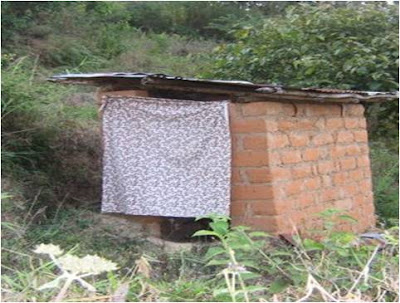
In Wongonyi Village, Kenya most of the homes do not have bathrooms or if they do they are not in good condition, much like the original pit latrine at the Mdawida home in the top photo. After having attended a Water and Sanitation Workshop (led by the CAWST - Centre for Affordable Water and Sanitation Technology) teaching Biosand Water Filters and proper pit latrines, Ronnie taught local youth to build proper pit latrines. You can see in the next two photos the beautiful new pit latrine they built prior to our visit in 2008. A proper western style bathroom with adequate ventilation meant that local families could now exercise proper personal hygiene.

On World Toilet Day we are trying to raise awareness of the importance of proper toilet use and techniques which in turn leads to improved health, and less days away from work and school because of illness. For more information on World Toilet Day, check out the website http://www.worldtoilet.org/


Monday, November 15, 2010

November 15 - National Philanthropy Day

"I never look at the masses as my responsibility. I look at the individual. I can only love one person at a time."

Mother Teresa

"Ronnie gives vegetable seeds donated by Baker Creek Heirloom Seeds to Monica, a microfinance participant."

Wow - did you know that today, November 15th is National Philanthropy Day. Now you might think that a philanthropist is someone who has a lot of money, so much so that they have extra to give away to charitable causes. But not so, each and every one of us can be a philanthropist - it only takes a small act.

On Friday we screened the documentary "a small act" about how one woman's small act of a monthly donation to sponsor a young boy in Kenya resulted in that boy, now a man, starting his own small act of an education fund for the students in his small village. We showed this film because it mirrored our own small act of starting The Ronnie Fund for our "Kenyan" son, Ronnie Mdawida, by simply saving pennies in a jar for Ronnie's university education. Now four years later and through the generosity of others who have participated in their own small acts by partnering with us we have been able to effect great changes in Wongonyi Village, Kenya. But there are still more challenges and issues to face. Our message with The Ronnie Fund is that it doesn't take great wealth to create change, each of us has the capacity to make a difference in just one other person's life and like drops of water that create ripples, the generosity will be spread.

As individuals we cannot solve world poverty, HIV/Aids or the plight of orphans in Africa, India or South America but each of us can make a difference by our own small acts and those collective acts can help achieve positive global change. Each of us have the capacity to help someone in need be it at home in our own community, our country or around the globe in a developing country to change a life for the better. For us, it was as simple as saving pennies in a jar.

Today on National Philanthropy Day, think about how you can change the world and donate today to your favourite cause (and remember philanthropy doesn't just mean money, it also includes your talents, skills and time).

"Change the world with a giving heart."

Friday, November 5, 2010

Microfinance - Small Loans, Big Impact


"Winnie - one of our microfinance recipients was able to expand her village shop."

Sometimes it is hard to imagine how a little financial boost can have such a huge impact. Microfinance is the term for small loans to business people who otherwise would not qualify for funding. In our village of Wongonyi, Kenya the local bank had few funds available for loaning out to those who wanted help to improve their businesses. So The Ronnie Fund started a Microfinance Program.

Through the generosity of a donor with an interest in Microfinance, we launched our program with six recipients. A year later we are pleased to report that the original six have repaid their loans and we recently provided another 12 participants with funding for their business projects which include a poultry business, grocery and cereal shops, goats, dairy farm, barber, tree nursery, carpentry, agricultural inputs, butcher shop, agrovet store, sewing and farming.
Ronnie meets with potential participants to determine their eligibility and assess their business plan. Once selected the participant signs documentation agreeing to a repayment plan. Ronnie also arranges for training in business skills so that we achieve a 100% success rate in repayment. This training also assures that our participants have the needed business knowledge to ensure a successful and expanding business.

For many of the people in our remote rural village, Microfinance has been just the impetus they have needed to move forward in their lives creating much needed income so they can support their families with food, clothing and school fees. We have found that our Microfinance Program is the perfect tool for helping to move people from poverty to prosperity. It truly is a testament to the fact that a small amount of money can have a tremendous impact in changing lives.

Monday, October 11, 2010

Thanksgiving - A Time for Giving Thanks

"As Christians, we can't love the whole world. But we should remember that God has placed us in a specific community at a particular time. We're called to love those around us. Loving them means serving them - and in doing so, we become the best citizens."

C.S. Lewis

It's Canadian Thanksgiving this weekend and a time for giving thanks - for all the blessings that we have. I for one truly understand C.S. Lewis' quote for I feel that I have been placed on this earth to love and serve others and in doing so become the best citizen I can.

I am truly thankful that I could cook my family's turkey in an oven and not over the smoky fire that my friend Getrude has to cook over in her tiny windowless kitchen building in Wongonyi Village, Kenya. I'm thankful for being able to flick a switch and have light at night instead of having to use a fumy paraffin lamp that causes respiratory problems. I give thanks that our family can afford school expenses and food each day instead of having to worry where our next meal is going to come from or having to send my children out to work because we can't afford school fees, uniforms and textbooks.

There are many in the developed world who really don't know how truly blessed they are with what they have. In the developing world around the globe, there are millions of people who struggle each and every day just to have basic necessities of life like clean, safe water, education, food, clothing and a safe roof over there head at night. There are millions of children who have been orphaned as a result of HIV/Aids, other diseases and simply poverty - families who have to give up their children because they can no longer afford to provide for them.

On this Thanksgiving holiday, we ask you to remember those who have so little and we who have so much. Life is about gratitude and sharing the great riches we have with others in your own community and around the globe. Love others - volunteer at your local Food Bank, an Out of teh Cold Program or give generously to Share the Warmth programs and if you have been touched by others in the developing world, volunteer and share your talents and expertise around the globe like teaching business skills, working in an orphanage or help building a school in Kenya, Guatemala, India, China or Ecuador.

Thanksgiving - it's a time for giving thanks!