I didn't know it until I heard it on the CBC this morning that today was Mahatma Gandhi Day, a day to celebrate the life and message Gandhi had for the world. If you don't know about Gandhi, he was the leader of India's struggle for independence, a spiritual teacher who moved people to adopt a life of peace. Unfortunately Gandhi died on January 30, 1948 at the hand of an assassin.
He had an extraordinary life from a boy growing up in India, to a student of law in London, then working to achieve legal equality for Indians and Negroes in South Africa and his final years spent back in India helping to secure India's independence. In his later years he developed a great spirituality which attracted many followers and his teachings still live on today for those of us who seek a world where all people are equal and live without poverty. He lived a life of passion and non-violence and encouraged others to do the same.
Mahatma Gandhi made many pronouncements during his life which if followed today would result in a world of peace. I have included some of Gandhi's sayings that resonate with me and I know that if others took heed of Gandhi's words I am sure we would all be able to enjoy a harmonious world where all could live in equality.
Here are some of Mahatma Gandhi's thoughts and sayings:
" Unity in diversity - The need for the moment is not one religion but mutual respect and tolerance of the devotees of different religions."
"On the reduction of poverty - Industrialization will increase India's grinding pauperism. Instead of increasing mass production, let us look to production by the masses."
" His ideal village would be a complete republic, independent of its neighbours for its vital wants and yet interdependent for many wants in which dependence is a necessity including growing its own useful crops, providing clean water, schools, theatre, public halls and electricity in every hut. For Gandhi self governing and self reliant villages trading with nearby self-sufficient villages was his recipe for democracy."
" All my life I have stood, as everyone should stand, for minorities and those in need . . ."
The Ronnie Fund stands for those in need in Wongonyi Village, Kenya who need not a hand out but a hand up, for these proud African people really know the solutions to their own problems they just need a few ideas and perhaps a tool or two to help them realize their potential.
So today we celebrate all that Mahatma Gandhi stood for - for those in the minority, those in need, those who have not been treated justly, those without the simple basic necessities of life. Take a look at your own life, if you have been blessed then pass your blessings on to others go without.
Showing posts with label Poverty. Show all posts
Showing posts with label Poverty. Show all posts
Tuesday, October 2, 2012

Monday, October 11, 2010
Thanksgiving - A Time for Giving Thanks
"As Christians, we can't love the whole world. But we should remember that God has placed us in a specific community at a particular time. We're called to love those around us. Loving them means serving them - and in doing so, we become the best citizens."
C.S. Lewis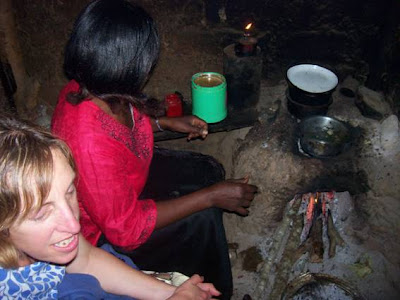
It's Canadian Thanksgiving this weekend and a time for giving thanks - for all the blessings that we have. I for one truly understand C.S. Lewis' quote for I feel that I have been placed on this earth to love and serve others and in doing so become the best citizen I can.
I am truly thankful that I could cook my family's turkey in an oven and not over the smoky fire that my friend Getrude has to cook over in her tiny windowless kitchen building in Wongonyi Village, Kenya. I'm thankful for being able to flick a switch and have light at night instead of having to use a fumy paraffin lamp that causes respiratory problems. I give thanks that our family can afford school expenses and food each day instead of having to worry where our next meal is going to come from or having to send my children out to work because we can't afford school fees, uniforms and textbooks.
There are many in the developed world who really don't know how truly blessed they are with what they have. In the developing world around the globe, there are millions of people who struggle each and every day just to have basic necessities of life like clean, safe water, education, food, clothing and a safe roof over there head at night. There are millions of children who have been orphaned as a result of HIV/Aids, other diseases and simply poverty - families who have to give up their children because they can no longer afford to provide for them.
On this Thanksgiving holiday, we ask you to remember those who have so little and we who have so much. Life is about gratitude and sharing the great riches we have with others in your own community and around the globe. Love others - volunteer at your local Food Bank, an Out of teh Cold Program or give generously to Share the Warmth programs and if you have been touched by others in the developing world, volunteer and share your talents and expertise around the globe like teaching business skills, working in an orphanage or help building a school in Kenya, Guatemala, India, China or Ecuador.
Thanksgiving - it's a time for giving thanks!
C.S. Lewis

It's Canadian Thanksgiving this weekend and a time for giving thanks - for all the blessings that we have. I for one truly understand C.S. Lewis' quote for I feel that I have been placed on this earth to love and serve others and in doing so become the best citizen I can.
I am truly thankful that I could cook my family's turkey in an oven and not over the smoky fire that my friend Getrude has to cook over in her tiny windowless kitchen building in Wongonyi Village, Kenya. I'm thankful for being able to flick a switch and have light at night instead of having to use a fumy paraffin lamp that causes respiratory problems. I give thanks that our family can afford school expenses and food each day instead of having to worry where our next meal is going to come from or having to send my children out to work because we can't afford school fees, uniforms and textbooks.
There are many in the developed world who really don't know how truly blessed they are with what they have. In the developing world around the globe, there are millions of people who struggle each and every day just to have basic necessities of life like clean, safe water, education, food, clothing and a safe roof over there head at night. There are millions of children who have been orphaned as a result of HIV/Aids, other diseases and simply poverty - families who have to give up their children because they can no longer afford to provide for them.
On this Thanksgiving holiday, we ask you to remember those who have so little and we who have so much. Life is about gratitude and sharing the great riches we have with others in your own community and around the globe. Love others - volunteer at your local Food Bank, an Out of teh Cold Program or give generously to Share the Warmth programs and if you have been touched by others in the developing world, volunteer and share your talents and expertise around the globe like teaching business skills, working in an orphanage or help building a school in Kenya, Guatemala, India, China or Ecuador.
Thanksgiving - it's a time for giving thanks!
Saturday, September 19, 2009
The Bottom Billion - moving people out of poverty
I have just finished reading "The Bottom Billion, Why the Poorest Countries are Failing and What Can be Done About It" by Paul Collier. It has been an interesting read on global poverty. The book focuses on the poorest of the poor countries who have gone unnoticed by the West. Collier contends that the causes of the failure of these countries can be attributed to several traps including extraction and exportation of natural resources, civil wars and bad governance and that aid and globalization can hinder rather than help these countries climb out of poverty.
A couple of Paul's comments really resonanted with me and with the work we are doing in Kenya through The Ronnie Fund. Paul says, "...development is about giving hope to ordinary people that their children will live in a society that has caught up with the rest of the world. Take that hope away and the smart people will use their energies not to develop their society but to escape from it - as have a million Cubans. "
Collier goes on the further explain the impact of the migration of educated people from developing countries - that globalization has led to emigration of the brighest and best skilled and knowledgeable people leading to skills shortages in the poorest countries hindering the development process. Collier notes, "This all adds up to a depressing picture of what globalization is doing for the bottom billion. To get a chance to play in the global economy, you need to break free of the traps, ... in order to turn a country around it helps to have a pool of educated people, but the global labor market is draining the bottom billion of their limited pool of such people."
We realize that education is the key to improving quality of life and we especially support those like Ronnie Mdawida who pursue further education and then pass that information on to others or use their newly gained skills and knowledge to create a better quality of life for their countryman instead of leaving their homeland for greener pastures abroad. I think Collier nails it on the head when he says, "In every society of the bottom billion there are people working for change, but usually they are defeated by the powerful internal forces stacked against them. We should be helping the heroes. So far, our efforts have been paltry: through inertia, ignorance, and incompetence, we have stood by and watched them lose."
In poor countries across our planet there are heroes like Ronnie Mdawida in Kenya, young men and women with dreams of making their country a better place to live, to lift their fellow humans out of poverty and achieve quality of life. We salute, encourage and support those individuals to keep believing in their dreams and we along with others who share a belief in common justice and human rights will help, in respectful ways, to make those dreams a reality.
Sunday, June 21, 2009
Books on Poverty - How We Can Better Achieve Successful Development
As we continue on this journey with The Ronnie Fund and our daily discussions with Ronnie about the approaches we should be taking to achieve continued success with our many projects currently underway in Wongonyi Village, I have been reading a variety of books on international aid and development. They have all been extremely interesting and I am learning a great deal about the aid business. Some of the books are quite disturbing on the amount of money spent by governments and organizations on aid but still poverty exists as just a drop in the bucket every really gets to those who really need it. And yet other books like "Out of Poverty" give one a sense of hope that improved quality of life can actually be achieved. The successes small grassroot organizations like The Ronnie Fund are achieving is because funds and tools get directly into the hands of local villagers and when training is provided the success rates are even greater. Perhaps these books will help shed some light on international aid and how best to implement it.
"Lords of Poverty, the Power, Prestige and Corruption of the International Aid Business"
by Graham Hancock, Atlantic Monthly, 2001
This is an interesting expose of the wastage in the international aid and development business. Using real life examples, I was shocked by the amount of money given to internatinal aid but how little of it actually reaches the people it is intended to help and those who are employed in the aid business who can sit and eat lavish meals while discussing how they are going to help those who eat only one meal a day, if that.
"The Trouble with Africa, Why Foreign Aid Isn't Working"
by Robert Calderisi, Palgrave MacMillan, 2006
Another publication that exposes how little funding actually reaches the poor in developing countries and the lack of accountability by those aid workers in the field. Robert's own admission that in his first placement in Africa, he had only one black friend for his socializing was spent with ex-patriates and he rarely ventured into the countryside. On his second posting to Africa, he spent most of his time travelling across the country and really getting to know those in rural villages and their needs but having to often explain why aid wasn't getting to them.
"Out of Poverty: What Works When Traditional Approaches Fail"
by Paul Polak, Berrett-Koehler Publishers Inc. 2008
Paul Polak's book focuses on the grassroot approaches to overcoming poverty. His philosophy is that if people are given the tools like irrigation pumps and systems they can grow enough food for their own consumption and have surplus to sell. Once they have income they can purchase education, health services, etc. He uses real life examples of people in the developing world who have been able to change their lives. When tools are made available directly to disadvantaged people, and not lost on large aid projects which can have funds redirected by corruption, improvements in the quality of life can be achieved.
Subscribe to:
Posts (Atom)